Introduction
Manc-COJO is a software tool for multi-ancestry conditional and joint analysis (COJO) of GWAS summary statistics.
GWAS tests for association between a trait and SNPs one at a time, giving marginal SNP effect estimates. However, associations detected in GWAS are often not independent because of linkage disequilibrium (LD) between SNPs. To address this challenge, COJO has been proposed and widely used for single-ancestry analyses, which identify independent association signals through iterative conditioning on significant SNPs while jointly modelling their effects to account for LD. Building upon COJO, our multi-ancestry extension exploits population-specific LD differences to improve the detection of independent association signals and reduce false positives compared to single-ancestry COJO (and ad hoc adaptations for multi-ancestry use).
Our software can also perform single-ancestry COJO and reproduce the results of GCTA-COJO, but runs substantially faster.
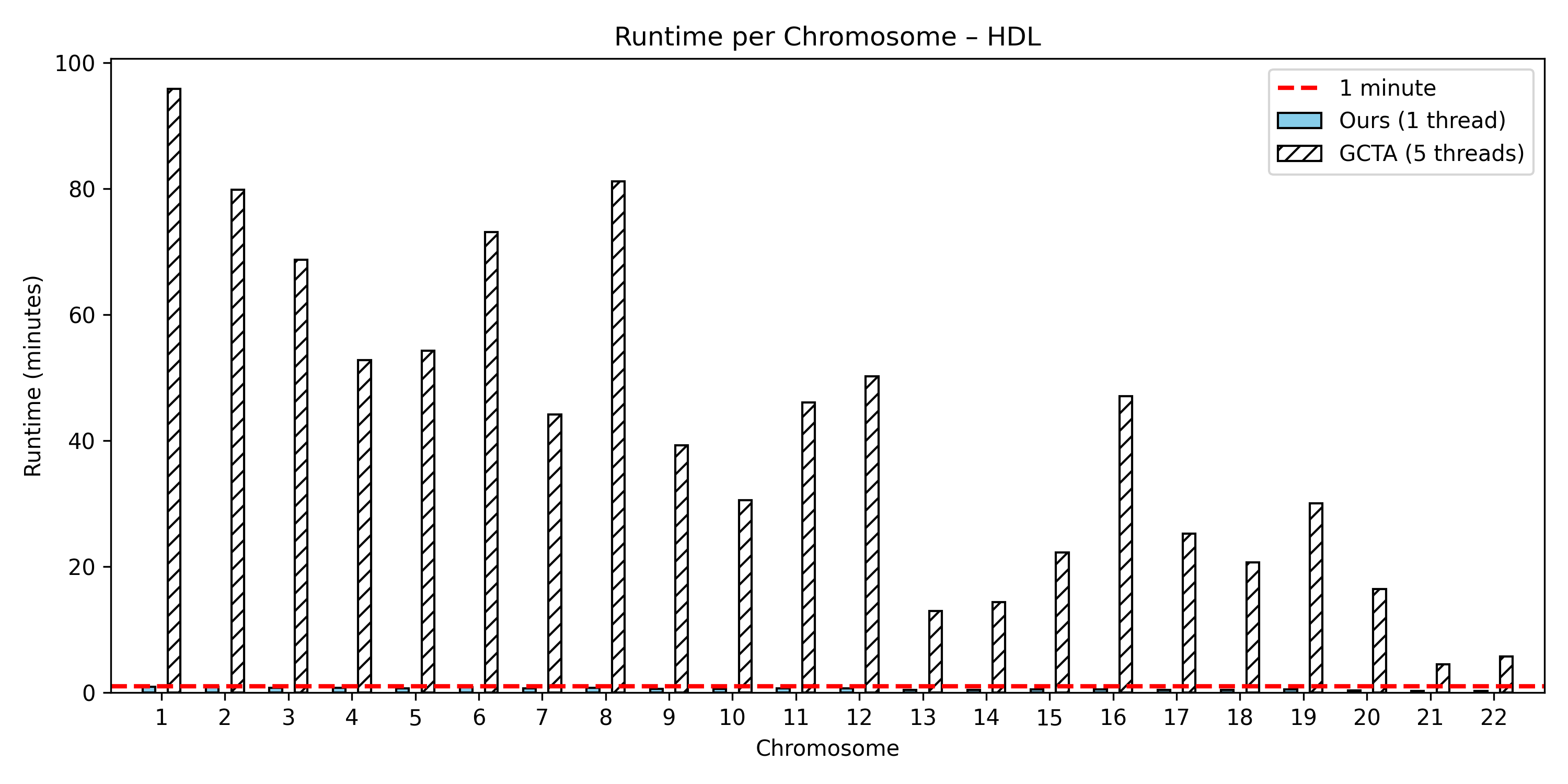
For example, for the analysis of high-density lipoprotein (HDL) cholesterol in our study, involving ~6.5 million SNPs and 76,000 individuals, we compared the per-chromosome runtime of Manc-COJO (using 1 thread) with GCTA-COJO (using 5 threads), as shown below. According to the Green Algorithms calculator, this translates into ~250× reduction in both carbon footprint (1.16 gCO₂e vs 289.08 gCO₂e) and energy consumption (5.02 Wh vs 1.25 kWh).
Please see this documentation website for installation, usage tutorials, supported command-line options, and additional details.
Citation
If you find our paper or software useful for your research, please consider citing our paper:
Multi-ancestry conditional and joint analysis (Manc-COJO) applied to GWAS summary statistics. Xiaotong Wang, Yong Wang, Peter M Visscher, Naomi R Wray, Loic Yengo. bioRxiv 2026.01.30.702783; doi: https://doi.org/10.64898/2026.01.30.702783
Support
- Contact Mark (xiaotong.wang@psych.ox.ac.uk) for algorithm-related questions.
- Contact Yong (yong.wang@psych.ox.ac.uk) for software-related enquiries and bug reports.
- We welcome GitHub issues, including usage feedback and new feature requests, so that discussions are visible to all users.